Product-Market Fit (PMF): A Framework for B2B Founders

The Four Levels of Product-Market Fit: A Framework for B2B Founders
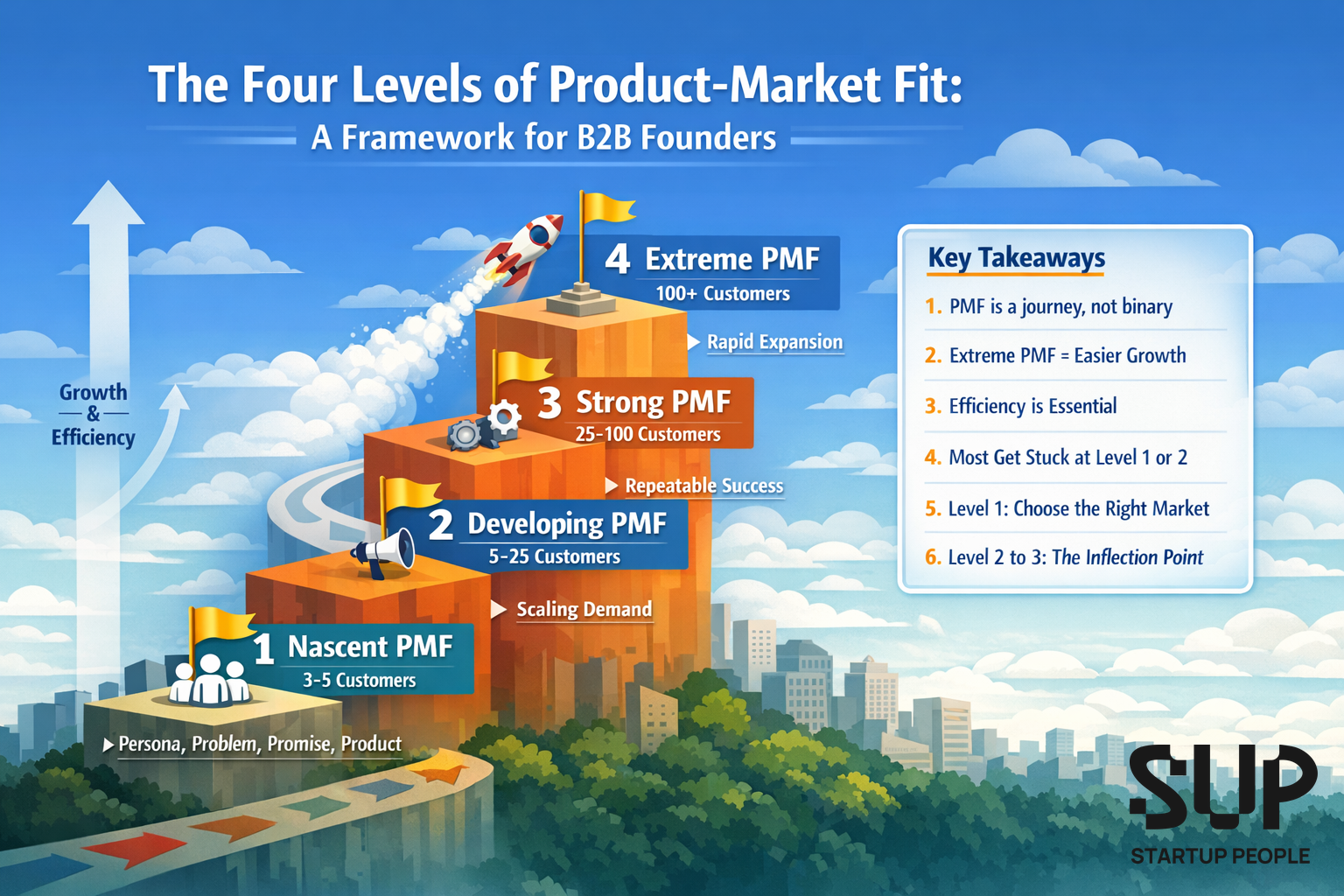
Key Takeaways
1. PMF is not binary—it's a journey through four distinct levels
2. Extreme PMF means the marginal customer gets easier—this is the ultimate test
3. Efficiency matters—demand and satisfaction without profitability isn't real PMF
4. Most companies get stuck at Level 1 or 2—use the Four Ps to pivot dramatically, not incrementally
5. Spend time at Level 1—picking the right market determines everything
6. Level 2 to Level 3 is the inflection point—this is where it stops feeling like pushing a boulder uphill
Most people describe finding product-market fit as an art, not a science. But Todd Jackson, Partner at First Round Capital and former VP of Product at Dropbox, has developed a practical framework that transforms PMF from an abstract concept into a measurable, achievable goal.
As a founder, you're juggling countless priorities: hiring, fundraising, building features, and closing deals. But here's the hard truth: if you find extreme product-market fit, everything else becomes easier. The market pulls you along, customers tell you what to build, hiring becomes simpler, and growth feels inevitable.
Without it? You're pushing a boulder uphill—and the majority of startups get stuck before reaching true PMF.
The Four Levels of Product-Market Fit
Level 1: Nascent PMF (3-5 Customers)
Goal: Find 3-5 customers with a problem worth solving and deliver a satisfying solution.
Focus: Satisfaction first, efficiency last
Benchmarks:
Pre-seed/seed stage, <10 people
$0-500K ARR
Demand mostly from warm intros
~20 warm intros needed per customer
It's okay to be completely inefficient
Example: Vanta didn't start with a product. Founder Christina Cacioppo manually filled out compliance spreadsheets for early customers like Segment, Front, and Figma. When one customer said Vanta's work would unlock a Fortune 10 deal, she knew she'd found a problem worth solving. The promise was clear: "This will unlock revenue for you."
Yellow Flags You're Stuck:
If your product disappeared, customers wouldn't be disappointed
Each customer values different features (you're doing consulting, not building a product)
Low usage despite having customers
Stuck at this level for 12+ months
What to Do: Use the Four Ps framework (see below) to pivot.
Level 2: Developing PMF (5-25 Customers)
Goal: Scale from 5 to 25 satisfied customers by opening demand floodgates.
Focus: Demand becomes critical, maintain satisfaction
Benchmarks:
Seed/Series A, up to 20 people
$500K-5M ARR
Early signs of scalable channels (cold outreach, content, events)
~10% sales conversion without warm intros
10-20% regretted churn is acceptable
Magic number: 0.5-0.75
NRR: at least 100%
Example: Looker spent significant time at Level 1 (founder Lloyd Tabb did 20-30 hours of consulting per customer before they bought), but once they nailed their "forward deploy" process, they flew through Level 2 with a 75% close rate and zero churn.
Yellow Flags You're Stuck:
Struggling to open demand floodgates after 12-18 months
>20% regretted churn
Long sales cycles with low ACV (the "quadrant of death")
Customers say "not the right time" or "no budget"
What to Do: This is the most common place to get stuck. You need at least a 200% pivot, not a 10% pivot. Change your positioning, persona, or problem dramatically.
Level 3: Strong PMF (25-100 Customers)
Goal: Achieve repeatability where the marginal customer gets easier.
Focus: Efficiency joins satisfaction and demand
This is where it starts to get fun. The boulder rolls downhill. Fish jump in the boat.
Benchmarks:
Series B, 30-100 people
$5M-25M ARR
At least one scalable channel working
10%+ of demand from referrals/word of mouth
~$75K average ACV
Gross margin >60% (ideally >70%)
Burn multiple <3 (ideally close to 1)
<10% regretted churn
>110% NRR
Quote from Retool founder David Hsu: "Every customer we got, whether number 4 or 14, felt like the last customer we'd ever find. It felt like rolling a stone uphill. That feeling lasted until we had a few million in ARR—that's when the boulder went down the other side."
Yellow Flags You're Stuck:
Leaky bucket: NRR <90%
Growth slowing despite increasing spend
Your first channel is saturated, haven't found a second
Lots of competition emerging
Level 4: Extreme PMF (100+ Customers)
What is Extreme PMF?
Extreme product-market fit means the marginal customer gets easier, not harder.
When you have extreme PMF, acquiring customer #100 is easier than customer #10 was. The boulder rolls downhill. Fish jump in the boat. Growth feels inevitable rather than forced.
Concretely, this means:
Customers are actively seeking you out, not just responding to outreach
Word-of-mouth and referrals drive a meaningful portion of pipeline
Sales cycles shorten over time
Your product practically sells itself because the value is obvious
Customer acquisition becomes more efficient (lower CAC, faster payback)
The market pulls you forward instead of you pushing into it
Goal: Maintain all three dimensions (demand, satisfaction, efficiency) while expanding TAM.
Focus: Multi-product strategy, new markets
Benchmarks:
Series C/D+, 100+ people
$25M+ ARR
Multiple scalable channels
>15% sales conversion rate
Magic number >1
CAC payback <12 months
Gross margin >80%
Burn multiple <1
<10% churn, >120% NRR
The Challenge: You must find product-market fit over and over again with new products. Examples:
Vanta: Expanded from SOC 2 to security questionnaires, vendor risk management
Stripe: Payment processing → Radar → Atlas → more
Square: Square Stand → Cash App → Square Checking → Square Loans
Reality check: Only ~30-40% of companies make it to Level 3 or 4. Most (60-70%) get stuck at Level 1 or 2.
The Three Dimensions of Product-Market Fit
Extreme product-market fit requires three elements working together:
1. Demand - Widespread need for your product
2. Satisfaction - Your product delivers on a critical promise
3. Efficiency - You can deliver repeatably and profitably
Most founders focus only on the first two. But efficiency is what separates companies like WeWork (high demand, high satisfaction, poor economics) from true success stories. Think of it as the "$100 vending machine" test: if you built a machine that gave $100 for every $1 inserted, you'd have incredible demand and satisfaction—but a completely unsustainable business.
Discovery & The Four Ps: Your Framework for Pivoting
When you're stuck at any level, systematically evaluate what to change using the Four Ps:
1. Persona - Who are you selling to? (Think of this as a collection of specific people, not an abstract market)
2. Problem - What specific pain point matters most?
3. Promise - What value are you committing to deliver?
4. Product - How does your product fulfill that promise?
Real Examples:
Lattice: Kept the persona (HR leaders) but changed problem, promise, and product (from OKRs to performance management)
Vanta: Changed all four (tried B2B Alexa and dropshipping before landing on compliance)
Plaid: Kept the product (bank account connections) but changed persona, problem, and promise (from consumer budgeting to developer API)
Ironclad: Same product idea, different positioning (from "AI legal assistant" to "CLM with AI"—playing in existing category vs. creating new one)
Dollar-Driven Discovery: Ask Better Questions
Most founders do customer discovery wrong. They get "happy ears"—hearing what they want to hear. Here's Todd's framework for better conversations:
Step 1: Identify Extreme Value
"What are your top 3 goals for the next 3 months?"
"What's hard about achieving those?"
Present your solution and look for "WOW" statements (not "that's interesting")
Step 2: Confirm Ability to Pay
"Are you currently looking for or building a solution to this?"
"Where would budget for this come from?"
"How does your team make decisions on third-party tools?"
Step 3: Quantify Willingness to Pay
"What's a fair price for this?" (They'll lowball)
"What would be expensive?" (They'll probably pay this if it's good)
"What would be prohibitively expensive?" (This is actually too much)
Look for demonstrated interest: "Can we meet again next week?" or "Can you send me the deck to share with my team?"
Market Selection: Picking the Right Persona & Problem
Founders spend 99% of their time building and 1% picking what to build—but picking the market determines everything.
Timeline: Getting to Level 4 typically takes 4-6 years:
Level 1: 12-18 months (spend time here—picking the right persona and problem is the most important decision)
Level 2: ~1 year (if you nailed Level 1)
Level 3: ~2 years (scaling from $5M to $25M)
Level 4: 1-2+ years (beyond $25M)
The companies that move fastest spent adequate time at Level 1 ensuring they had the right foundation.
Founder-Led Sales: Your Superpower at Early Stages
At Levels 1 and 2, you are the sales team. This isn't a limitation—it's your competitive advantage. You can:
Learn faster than any sales rep could
Adapt your pitch in real-time
Build deep relationships with early customers
Understand objections at a fundamental level
The goal isn't to close every deal—it's to learn what resonates and what doesn't.
Positioning: Playing in the Right Category
How you position your product matters enormously. Ironclad's pivot from "AI legal assistant" (creating a new category) to "CLM with AI" (playing in an existing category) changed everything. Buyers already understood CLM; they just needed to know this version had AI capabilities.
Product Iteration & When to Pivot
If you've been stuck at Level 1 or 2 for 12-18 months, it's time for a significant change—not a minor tweak. The companies that successfully pivot make 200% changes, not 10% improvements.
When to give up: If you've been at it for 4-5 years without reaching Level 3, the odds of suddenly finding PMF are low. There's no shame in returning capital to investors or finding a soft landing—product-market fit is extraordinarily hard, which is exactly why this framework matters.
Listen av view to the Full Conversation
This article is based on Todd Jackson's (First Round Capital) conversation with Lenny Rachitsky on Lenny's Podcast. For the complete discussion with additional insights and stories, listen to the full episode: A framework for finding product-market fit: https://www.youtube.com/watch?v=0LNQxT9LvM0).
Want to go even deeper?
First Round Capital's Product-Market Fit Method program helps B2B founders in their first 6-12 months find PMF faster. Learn more at pmf.firstround.com.
Read more on product and PMF on SUP:
Fake product/market-fit ❌ (YC): https://www.startuppeople.com/articles/product-software/fake-pm-fit
Product Building Process (YC): https://www.startuppeople.com/articles/product-software/product-building-process